Showing posts with label The Death of Michael Jackson. Show all posts

Friday, June 25, 2010

My Top 10 Most Played Michael Jackson Songs Ever

On the one year anniversary of the loss of pop's definitive king, would I honestly go without doing a list?

Of course not.

Instead of going through Michael's entire back catalog and choosing his greatest, I decided to go into my iTunes library and look out how many times I've played his music. It turns out that many of the songs I would've chosen for a Top 10 list were in my own personal Top 10 most played. So, I've decided to share my most played Michael Jackson songs (as of today).


10. Stranger in Moscow (114 plays) - Michael's 1997 single from his album HIStory is one of his most personal recordings, as well as one of his most affecting. On an album that expressed his outrage and anger over the world's treatment of him, it was this record that really conveyed the most common feeling of his life: loneliness.

9. Beat It (116 plays) - That Van Halen guitar riff. Michael's growling vocals. Those warnings of danger. It could only be "Beat It", his 1983 blockbuster that helped Thriller become a multi-million seller. This was the song that proved his skill at genre-busting; "Beat It" is clearly a rock song, yet was played by R&B and pop radio. Even though it's 27 years old, it still packs the punch it did in the beginning, hence it being played over 100 times by me.

8. You Rock My World (119 plays) - It still surprises me to this day how this song only peaked at #10 on the charts. Sure, it doesn't stand as tall as Michael's other classics, but it was classic Michael. It was funky, melodic, and Michael sounded in top form, even taking a slightly lower tone. It was also one of the first MJ songs of my generation, which also explains my penchant for it.

7. Jam (153 plays) - Michael opened his Dangerous Tour in 1992 with this hard-driving song, and I fell in love with it. "Jam" was a powerful fusion of new jack swing and rock, which would be the signature sound of his later releases. Of course, this was the gold standard. Why is there such a gap between this and "You Rock My World"? Because this was my favorite song of his to dance to.

6. Scream featuring Janet Jackson (171 plays) - I love Michael. I love Janet. Them together? How about a match made in heaven? A match I love playing whenever my Top 200 playlist is on my iPhone.

5. You Are Not Alone (203 plays) - This song made history as the first song to debut at the top of Bllboard Hot 100. It is also one of his best songs ever in my opinion (he didn't write it, by the way). Of course, immediately after his death, I had this song on repeat, maybe for hours.

4. Black or White (213 plays) - I've always loved this song, ever since I saw the music video. It has a positive (albeit ironic) message and it's got a kickass guitar riff courtesy of Slash; what else do you need. Of the songs in the Top 10, this may be one of the two easiest to listen to continuously for me.

3. Billie Jean (214 plays) - The definitive Michael Jackson song, "Billie Jean" is everything that Michael stood for as a pop behemoth. Surprisingly, it's not my most played MJ song, but there is no denying this song's impact on the world of music.

2. Remember The Time (249 plays) - Some of my favorite Michael songs were the light, fun ones. This was probably his last one. "Remember The Time" was a pure R&B record, and it was one of his best. He sounded like he was having a great time on this record, and this was the Michael I wanted to remember, which is why it has so many plays ahead of the other eight songs on the list. 

1. Man in the Mirror (307 plays) - This is my favorite Michael Jackson song, and it is in my Top 20 of my most played of all time. All I can say is that it is a beautiful, brilliantly constructed ballad about personal responsibility for the world around us that gained all kinds of significance at his passing. In the weeks following his death, I probably played this song more than any other in my 2500+ music library.

Michael Jackson, One Year Later


It's still hard to comprehend.

One year ago today, fresh off the sad news of iconic 70's actress Farrah Fawcett's passing from cancer, the world was dealt a bigger blow with news of the demise of Michael Jackson, the King of Pop.

I was sitting in my mom's car when I found out by email. I actually screamed at the wording "Michael Jackson Passes Away". It didn't seem possible at all, that a man on the verge of the biggest comeback in music history could just be gone. I prayed it wasn't true, that it was some cruel joke. But as I got home and turned the television on to MSNBC, then CNN, then ABC, and every other news channel that was covering the chaos in front of the UCLA Medical Center, it became startlingly clear.

Michael Jackson was gone.

I was a fan of Michael Jackson before I even knew who he was. I can remember being at a friend's party back in the late 90's and seeing the cover of Jackson's 1995 album HIStory. I didn't know he was at the time, but I knew he was important.

I truly gained an appreciation for him after my mom got us tickets for the 30th Anniversary Tribute at Madison Square Garden. Another young memory: me and mom squabbling over the $800 price of the tickets. In preparation, I bought every Michael Jackson album my mother didn't already own (except Blood on the Dance Floor). I listened to them almost every day, and I was mesmerized at how amazing his music was. But anyone who knows Michael knows that his music was only part of the package. When I watched him on stage at MSG, performing his greatest hits to a packed house of screaming fans, my mother and I included, I knew this man was the greatest performer I would ever know.

I stood by Michael ever since that concert, which would precede the devastating September 11th attacks on the World Trade Center. I credited Michael for saving my life; my mother would have most likely been caught in that disaster on her way to work. Instead, we both played hooky, just to watch the disaster unfold on television. I wouldn't say that I felt like I owed Michael, but I believed that he was worth my support. Even after the baby-dangling, that damning Martin Bashir interview, and the second round of child abuse allegations, I believed in him.

When Michael announced his concerts in London, I quickly went online to look up airline tickets. Me, a 17-year old senior in high school, wanting to drop at least $2,000 to see a 50-year old man perform under insurmountable pressures and expectations. Of course, I didn't buy those tickets, but I was hopeful that someone would sneak into the O2 Arena with a video camera (preferably HD) so I could watch in awe on YouTube.

It never got that far, unfortunately.

One year later, I'm sitting on my bed, listening to Michael Jackson's song "HIStory" as I type out this retrospective of Michael's importance in my life. There is no question that Michael was a complicated individual. Many adjectives can be used to describe him, some of which I'd rather not think about. Yet, there is no doubt for 41 years, since he wowed the world as a kid leading the Jackson 5, Michael commanded the conscious of popular culture. No matter which way he affected people, he affected them in such a way that it was impossible to imagine him gone.

Which may be why, 365 days after that shocking news hit the wires, it is still hard to comprehend the King of Pop is gone.

Then again, thanks to his indelible presence in the world, maybe he isn't gone after all. He sang in "HIStory" about the importance of making sure every day you live leaves a mark.

His will continue to live on.

Rest in peace, Michael Jackson.

Sunday, June 13, 2010

UNBELIEVABLE: MJ's Death Is Katherine's Fault, Says Joe Jackson


Just when you thought that Joe Jackson couldn't get any more reprehensible...

The Jackson patriarch decided to honor the one-year anniversary of his son's passing by blaming his wife Katherine for her son's demise. In a taped interview with British newspaper News of the World (the same tabloid that exposed Sarah Ferguson last month), he revealed that he told Katherine that Michael would still be alive if she had intervened more in his life. The tabloid also reported that Joe blew up at Katherine in the moments after Michael was declared dead. "I couldn't bottle up my feelings," Joe reportedly told the newspaper.

June 25th will mark the first anniversary of Michael Jackson's shocking death from an overdose of propofol. Joe believed that if Katherine had spent more time with him, then Michael would have been "relaxed" and healthier. He said that Katherine didn't want to invade Michael's privacy, an issue they argued about many times. Joe believed that Michael was looking "frail" and "a bit funny" in the last months of his life, and that Katherine could have made the difference.

Joe also talked about Debbie Rowe's involvement in Michael's children's lives. According to him, the kids do acknowledge her existence, and that she has spent time with them. He notes, however, that there isn't a closeness between them yet.

Joe Jackson has done some pretty questionable things since Michael's untimely passing, but blaming his wife for her son's death is the worst, by far. What makes it even more outrageous is that he is slating her so close to MJ's death anniversary. It makes a person (me) wonder how much he really cares about his family. Katherine is trying to raise her grandchildren in peace, while he is gabbing with tabloids about his private family matters.

Sunday, November 1, 2009

Michael Jackson's "This Is It" Tops Box Office

File:Michael Jackson's This Is It Poster.JPG

The King of Pop reigns again.

Despite overblown expectations, the Michael Jackson concert documentary This Is It has topped the American box office with a weekend gross of $21 million. It's overall total so far is $32 million.

The film (which I haven't seen yet) has received great reviews; Roger Ebert called it one of the most revealing documentaries he has ever seen. However, the film has performed below expectations, although the Halloween weekend is being listed as contributor.

On the music side of things, the soundtrack is expected to sell up to 350,000 copies this week, giving MJ is sixth #1 album, and his first since Invincible.

The movie is only in theaters for another week and half, so if you haven't seen it yet, go!

Monday, September 21, 2009

A New Michael Jackson "This Is It" Clip!!!


Here is the King of Pop performing "Human Nature" during the rehearsals for his London concert series.

I'm officially standing first in line to get tickets for this. Damn Michael and those who contributed to his death for taking this epic show away from us...

Monday, September 14, 2009

Michael Jackson's "This Is It" Dazzles The VMAs

Michael_Jackson's_This_Is_It_Poster.JPG.jpg

At last night's VMAs, the trailer for the "This is It" concert documentary closed a show that was warmly dedicated to Michael. There couldn't have been a better ending, because that 2-minute trailer was cold, hard evidence of Michael's dominance of popular music. Even at the age of 50, he appeared as agile and clean in his movements as ever. Had he lived, Michael would have put on the best stage show ever, with special 3D videos, elaborate sets, and the exceptional dance routines of songs like "Smooth Criminal".

For a man who, through the eyes of the media, didn't appear to have a coherent bone is his body, Michael was surprisingly alert and focused. In the trailer, besides his performance, you can see how he takes control of his own output. He's basically directing the show himself, with a little help from past choreographer Kenny Ortega.

The most promising aspect of the trailer and the movie is the promised personal element. The movie claims that it is a Michael we've never seen before. Actually, that's not true. Michael in the trailer is seen smiling and laughing, which we've seen on more than one occasion. It's just that we've never really paid attention. We all were so caught up in Michael Jackson's oddities that we never truly regarded him, like Madonna put so eloquently last night, as a human being, capable of laughter and happiness.

That is what this movie is about, more so than the concert that never was. "This Is It" is a reminder of two facts. Fact one: Michael Jackson was, and always will be, the King of Pop. Fact two: Michael Jackson was a human being. Both facts seem to have been lost in the last few years leading up to and in the aftermath of his death. However, I have a good feeling that this movie will set those two facts in the stones of the pop canon.

Thursday, September 10, 2009

Me To Jermaine Jackson: Shame On You!

Yesterday afternoon, Jermaine Jackson held a press conference in London to formally announce plans for a Michael Jackson tribute concert to be held in Vienna, Austria on September 26th. Performing at the concert, besides Jermaine of course, is Mary J. Blige, Chris Brown, Stevie Wonder, Natalie Cole, Akon, and more.

Actually, scratch Mary, Chris, and Natalie off that list, since their representatives claimed they never agreed to the show.

In fact, for good measure, cross off Stevie and Akon too, because I wouldn't be surprised if they pulled out as well.

That's because this show, meant to be a tribute to one of pop music's most iconic figures, is nothing but a posturing, indulgent, and tacky attempt to cash in on his death.

Now, I'm not saying that Jermaine is some callous money-hungry graverobber, but somewhere in the back of his mind, he has to know that this concert serves no purpose.

He claims that this was for Michael's European fans. As if they didn't have televisions and couldn't watch the official memorial when it was held in July. As if they didn't attend the viewing parties held all over the world. As if they didn't schlock by the tens of thousands to Michael's Dangerous and HIStory tours, which saw no dates in the United States.

And if you were going to hold such a concert, why the hell in Austria? No offense to the country, it's lovely, but Michael had zero connection to that country. How about the United States, where he was born? Or Romania, where he held his massive HBO concert in 1992? London? Paris? Berlin? All of these places would have made sense, but not Austria. Unless, of course, Austria was the only place that would hold such a farce on their soil, and that they are the only ones that would bankroll it.

There is no tangible reason for this concert's existence, which is why "performers" are dropping out left and right. This is simply more of the same; exploitation of a man who's seen it since the age of five. Even in death.

I know that money is a powerful motivator, Jermaine, but for the sake of your family, the fans, your dignity, and Michael, stop this stupidity and let your brother rest in peace.

MTV's MJ Tribute: Raining Gloves and Janet Jackson

On the day the world lost Michael Jackson, MTV suddenly remembered how they became the cultural touchstone they are today and paid immediate homage to the King of Pop. In an age where a music video channel spins reality shows nearly every minute, it was both refreshing and comforting to see MJ classics such as "Billie Jean", "Beat It", and "Black or White" on the air, in primetime, no less.

Three months later, MTV is showing their respect for Michael by dedicating a portion of the Video Music Awards, if not the whole show, to him. Despite the stagnant nature of recent VMA ceremonies, I knew that the definitive Michael Jackson tribute would come from them, especially after the disaster that was the BET Awards.

If the latest information and promo is to be believed, then they have proved me right.

MTV revealed this past week that Janet Jackson, Michael's little sister and pop icon in her own right, would helm the opening tribute. She's reportedly working with the best dancers in the industry, including MJ friend Wade Robson, to craft this performance.

On top of that, MTV released a surprisingly touching promo for the tribute, featuring raining silver gloves, Michael's most famous trademark.

If done right, and I am sure it will be, this could rank among one of the best ceremonies in VMA history.

The MTV Video Music Awards airs this Sunday, Spetember 13th, at 9pm EST.

Check out the promo below:

Thursday, July 30, 2009

IT'S TRUE! Joe Jackson Confirms Omer Bhatti As Michael Jackson's Son!


I KNEW IT!

Joe Jackson, in an interview with TV One here in America, has confirmed that Norwegian-born Omer Bhatti is the son of the late Michael Jackson.

He also acknowledged that he looks and acts like a Jackson, and is an excellent dancer. When asked if he could carry MJ's legacy, Joe said that he couldn't say until it happens.

The story officially broke when it was observed that Omer was sitting with Michael's other children and aunt Rebbie in the front row. It was revealed from there that Michael met Omer (who had gotten attention for be an excellent MJ impersonator) in Tunisia in 1996. Michael then took Omer and his family on tour with him and even moved them in Neverland Ranch.

It is believed that Michael Jackson, during a visit to Norway, had a one night stand with Omer's mother in the early 80's that resulted in Omer's birth.

Here are pictures of Michael Jackson's purported son Omer Bhatti:

http://famespy.files.wordpress.com/2009/07/michael-and-omer.jpg

http://famespy.files.wordpress.com/2009/07/mj-and-omer2.jpg

http://www.ktla.com/media/photo/2009-07/48243188.jpg

Tuesday, July 28, 2009

Did Dr. Murray FALL ASLEEP Giving Michael Jackson Death-Inducing Propofol?

 http://www.bbc.co.uk/blogs/ni/michael-jackson.jpg

Stunning revelations continue to be leaked in the weeks after Michael Jackson's shocking death, including how King of Pop's last hours were.

What may shock and enrage Michael's fans is the latest news coming from the Los Angeles Police Department. According to TMZ.com, speaking with multiple police sources, Dr. Conrad Murray, the "doctor" who was with him at the time of his death, admitted to police that he had administered Propofol to the singer hours before he died. He made this admission on June 27th, two days after Michael was declared dead. If you remember, there were reports that Murray had abandoned his car and essentially went missing in the immediate aftermath of Michael's passing.

The shockers don't stop there. The police, trying to piece together this sad story, are convinced that Murray was negligent in administering the extremely powerful anesthetic drug, which is used only in hospitals. It is even believed that, while the drug was continually being pumped in Michael's veins, Murray was asleep in his own room at Michael's rented L.A. mansion. While the doctor was allegedly asleep, the King of Pop's heart stopped beating as he went into cardiac arrest.

By the time paramedics arrived, Michael was dead and reportedly unrecognizable to them.

Murray's administration of the Propofol violated virtually every medical guideline. For one, Michael's vitals should have been monitored by either an EKG to watch his heart or a pulse oximeter to check his blood oxygen levels. Neither machine was present in the home. 

Murray's horrifyingly unprofessional behavior regarding Michael's health has been well-documented in the past month. Murray, apparently in shock, didn't call 911 for a half hour after he found an unresponsive Michael in bed. He practiced CPR, but not on a hard surface, as is protocol.

Court papers have named Murray as a suspect in the investigation that has been labeled manslaughter.

Thursday, July 9, 2009

Why Pelosi's Killing of the Michael Jackson Resolution Is a Good Thing, For Now

  http://wellsy.files.wordpress.com/2009/05/nancy-pelosi-attacks.jpg http://userserve-ak.last.fm/serve/_/29684553/Michael+Jackson+035.jpg

At Michael Jackson's massive, emotional memorial service at the Staples Center, Texas Congresswoman Sheila Jackson-Lee presented a resolution to honor the icon for humanitarian works and for his status as an American icon. The announcement of the resolution drew rapturous applause.

Today, House Speaker Nancy Pelosi effectively killed the resolution. Her reason for doing so was that discussions on the resolution would bring up "contrary views" that were "not necessary at this time" (she did acknowledge him as a "great, great performer"). Essentially, she is saying that the resolution has the danger of splitting up the House into two groups: those who love Jackson and those who despise him. That split would potentially be disastrous as the House tries to pass more important legislation, such as those involving healthcare.

The split was confirmed when Peter King, the classless New York congressman who called Michael Jackson a "pervert" and "pedophile" and appeared to relish in the attention those insults caused, promised he would block the resolution. Also, only one other congresswoman announced their support, while other members, including those from the black caucus, remained silent.

Right now, Congress needs to focus on bringing this country back from the gates of hell, not fighting over Michael Jackson's legacy. That would only drudge up the most unsavory of the pop star's history, which does nothing but tarnish an already spotty reputation.

While Michael Jackson's cultural influence, despite King's and Bill O'Reilly's opinions, is grand and undisputed, I have to agree that congressional recognition isn't something that should be prioritized. Maybe in the future, after all of the dust surrounding his death has settled and the issues most important are resolved, the resolution, whatever it would mean, can be reintroduced.

Mariah Carey Apologizes For MJ Memorial Perfomance: Should She Have?

http://www.latina.com/files/0708mariah_article_1.jpg

In a move that's quite stunning, Mariah Carey has apologized to her fans for her vocal performance at Tuesday's memorial for Michael Jackson at the Staples Center. The singer performed the Jackson 5 classic (and her 1992 #1 single) "I'll Be There" with Trey Lorenz. Afterwards, the pop diva wrote on Twitter, "Trying to sing today was basically impossible for me. I could barely keep myself from crying. I'm sorry that I wasn't able to pull it together and really do it right, but I was literally choked up when I saw him there in front of me."

The "apology" comes as a surprise since no one referred to her performance as bad at all. It was clear that Mariah wasn't up to form, especially compared to her vocals on the original. It is clear that she was choked up and very emotional upon seeing the casket, which likely affected her performance.


However, how much was grief, and how much was just a gradual change in her vocal ability, noticeable in the past few years. For instance, here is Mariah on David Letterman in 2005, singing "We Belong Together":


Here is her performance at the Inaugural Ball in January:


Finally, here she is performing at the memorial:


While Mariah's performance was hindered by the emotions of the day, it is clear that her live vocal performances have gotten progressively worse. At the same time, Mariah didn't need to apologize for her lacking vocal ability at the memorial. Both apparent causes of the performances were beyond her control, and she shouldn't be faulted for that.

"Morphine": Michael Jackson's Secret Drug Pain, in Song

File:Blood on the Dance Floor cover.jpg

The circumstances surrounding the death of Michael Jackson are still unclear, but prescription drugs are the most likely cause.

Michael has had a complicated history with prescription drug addiction. In 1993, the singer went into rehab after he became dependent on painkillers to fight the stress of his worldwide tour and the child molestation allegations against him. Then again, in 2005, rumors of Michael's self-medicating resurfaced as fought another wave of allegations and a trial.

Now, it has been revealed that in the last six months of his life, powerful drugs that treat chronic pain have been involved in Michal's daily routine. One of them was Demerol, the first drug name cited in Michael's death. However, it is not the first time that drug and the King of Pop have crossed paths.

"Demerol, Demerol, oh God, he's taking Demerol..."

Those are the words in Michael Jackson's 1997 song "Morphine", off the remix album Blood on the Dance Fllor: HIStory in the Mix. The album was largely ignored in the United States, just selling one million domestically. For the first time, he directly refers to his history painkiller abuse, dedicating the song title to morphine, a highly potent painkiller that hits the central nervous system. The song is broken into three parts; the first part features a hard-driving, screeching beat. While his post-allegation music was edgier than his earlier music, this song features Michael at his most harsh. Words of razor blades and buzzes, combined with this industrial-sounding beat combine to represent the chronic pain that Michael suffered. That fades in the second part, as a tender melody takes its place with Michael's soothing voice. Singing "Relax, this won't hurt you, before I put it in, close your eyes and count to ten", Michael sings as the morphine, eerily comforting its patient/victim. What's interesting, and even troubling, is in the background is the sound of beeping hospital equipment. Th third and final part crashes through the peace, bringing back the sharp slamming beat and the quick yells from Jackson. When the singer, who is known for his emotionally-filling vocal delivery, screams the word "morphine", it has a bite that can send chills down your back.

It's hard to tell whether "Morphine" was a reflection, a cry for help, or even a premonition. The haunting sound of Michael singing "Demerol" repeatedly is so disarming when current events are taken into account, and lends a sense of tragedy to this surprisingly great piece. You almost wish that someone repeated the above lyrics to Michael in the months leading to his shocking death.

Michael Jackson will be remembered for his brilliant pop masterpieces like "Billie Jean" and "Beat It", when he was in his supposed prime. Songs like "Morphine", "Stranger in Moscow", and "Childhood" from his more difficult years paint a deeper, richer, and more troubling picture of this man's true genius: his ability to turn personal struggles into universal themes.

Too bad no one listened; maybe then he wouldn't be where was today.

Listen to "Morphine" below, or download it on iTunes:

Michael Jackson and Princess Diana: Fallen Rulers of the Media Kingdom, Part 3

http://www.newprophecy.net/Diana_Princess_of_Wales_smiles_at_Tate_July_1_1997.jpg http://i.rollingstone.com/assets/rs/2/1650/images/00284706_lg.jpg

Michael Jackson and Princess Diana are unique in their celebrity because, as a new media age dawned, they attempted to control how they were seen by the world. There were times when it was successful, greatly so. However, by the mid-90's, the methods that worked for them early on began to lose effect, and they were trapped in their own special kind of media hell.

Princess Diana probably didn't realize the extent of reciprocal damage her 1995 Panorama interview would cause. While she succeeded in winning public favor again (especially after a friend of Charles called her mentally ill in a special after the initial airing, confirming her accusations of backdoor sabotage), her interview was looked upon kindly by the Palace. The Queen, apparently fed up with the media circus the family was subjected to by Diana's antics, wrote both her and Charles, suggesting a divorce, something Diana did not want (per the interview). Ultimately, she had no choice, especially after she slyly accused her sons' nanny Tiggy Legg-Bourke of aborting Charles' baby.

The early half of 1996 saw Charles and Di fighting over terms of a divorce. The most publicized aspect of the discussions was whether Diana would retain her title of Her Royal Highness, or HRH. According to the Queen, since Diana would be divorced from the prince, she had no right to the HRH. She had the title taken away, being restyled as Diana, Princess of Wales. The removal of the title hypothetically meant that Diana would have to curtsy to members of the family, even her own children. After the announcement, Diana announced that she was quitting a number of charities, choosing a select few to continue with. The media heavily implied that she did that as retaliation for losing her title. The media also reported of the changes in Diana's staff, who quit over lack of communication and trust with the princess. Divorce also saw an increased effort from the paparazzi to get pictures of her, particularly in a state of distress. Paparazzi followed her everywhere she went and, with a serious downsizing in security, were free to pester her into tears, which the media gladly attached headlines with.

http://img.thesun.co.uk/multimedia/archive/00101/ed_imgRSNN2307AA_101241a.jpgWhat her divorce didn't mean was that she would quit her charity work, and that the media wouldn't be used to promote it. In January of 1997, Diana teamed up with the Red Cross to create an international ban on landmines. She traveled to Angola, where news cameras from round the world documented her journey. That trip showed Diana exemplify both her compassion for suffering and her astute understanding of imagery. When Diana stopped to visit a severely injured girl in a hospital, she covered the girl's body from the prying cameras and demanded that they stepped back from scaring the sick girl. In another astonishing moment, Diana walked amongst active landmines in an uncleared field. When she realized that the media didn't get clear pictures, she did it again. Those pictures were published on front pages worldwide. Her visits to Angola and Bosnia brought unprecedented coverage to an issue often ignored worldwide. She was often cited for the creation of the Ottawa Treaty, which was signed by over 100 countries. Unfortunately, she wouldn't live to see the day.

http://www.martinfrost.ws/htmlfiles/diana_car.jpgOn August 30th, 1997, Diana was dining with her boyfriend at the time Dodi Al Fayed at the The Ritz Hotel in Paris, France. In the weeks prior, Diana and Dodi were heavily photographed frolicking on a yacht owned by Dodi's father Mohammed Al Fayed, owner of Harrod's. They continued their vacation in France, followed by the paparazzi. The photographers and fans were stationed in front of the hotel, and in an effort to escape them, they took the back way out of the hotel. Somehow, paparazzi on scooters were there and, driven by an inebriated Henri Paul, the lovebirds fled with paparazzi hot on their trail. Three minutes after their departure, Paul lost control of the car and it crashed into a pillar in the Pont D'Alma tunnel. Inside the wrecked car were a dead Dodi and Henri Paul, and a barely alive Diana and her bodyguard. As the princess lay dying in the car, lightbulbs flashed as the paparazzi took pictures. Eventually, the French ambulances arrived and took Diana to the hospital. Two hours of surgery was unable to repair the damage to her heart, and she declared dead at 4:00 am.

  http://mydailymirror.com/images/newspapers/1997/09/p19970901.jpg   http://mydailymirror.com/images/newspapers/1997/09/p19970906.jpg   http://mydailymirror.com/images/newspapers/1997/09/p19970904.jpg http://thetimetravellers.files.wordpress.com/2008/02/5.jpg

The news of Diana's tragic death shocked the whole world. The UK alone saw a massive outpouring of grief never experienced before. The tabloid newspapers, who at the time were covering Diana's relationship with Dodi, went into overdrive as they covered her death. Images of the princess at her most saintly adorned nearly every British paper. That didn't stop the public from blaming them for her death, since they used the paparazzi to get pictures of Diana. What wasn't known at the time was that pictures of Diana in the wrecked car were sent to the newspapers, ready for publishing. According to an interview with the editor of tabloid, they were ready to print the pictures, until it was announced that she had died. Almost immediately, he deleted all images from the database. In the late edition of News of the World the day of her death, they proudly proclaimed that they refused to print pictures of a dying Diana. The press got a lucky break when reports from Paris came in blaming Henri Paul for the crash. From then on, the press assigned themselves as the speakers of the public. They took the charge when it soon became clear that the millions who mourned Diana were furious that the royals weren't in London and that the Royal Standard wasn't flying at half-mast. The family was on holiday at Balmoral in Scotland, and the flag on flew when the Queen was in residence at Buckingham Palace, but it didn't matter. The press attacked the family for their lack of public grief. The Sun asked on their front page: "Where is our Queen? Where is her Flag?". The Daily Mirror also questioned their absence with this headline: "Your People Are Suffering. Speak To Us, Ma'am." Even in death, Diana had a significant hold on the media. What was becoming clearer was that an ample part of the hold came from the public who adored her. Sensing media and public apprehension (some papers were publishing reports that many mourners weren't against abolishing the monarchy), the family returned to London.
https://blogger.googleusercontent.com/img/b/R29vZ2xl/AVvXsEgqFJ57Raht569zwOn0Z6bKvt-TUbMAlp6lFjshFRqnoRaNayb6XEwfJcfFNF5GgZFzzu1fo2OVViB8SOuKjEr5JFhwNHZKBHfIUZR_50A2t8qmUvpSUse4ANQTBDxcq_pmzCYRLRgVolJd/s320/diana_process.jpg http://www.royalanecdotes.com/wp-content/DianasFuneral_01.jpg http://media-2.web.britannica.com/eb-media/42/23142-004-1364D4E1.jpg

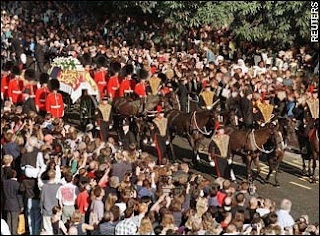
Their return saw a series of precedent-breaking actions. First, the Union Jack was flown at half-mast on the day of her funeral. The day before, the Queen delivered a television broadcast, speaking to the world in tribute to Diana. Despite reported troubles between the two of them, the Queen regarded Diana as "an exceptional and gifted human being". It was her first ever television broadcast, just another sign of the extraordinary reaction, media and public, to her death. While some accused both reactions of being grotesquely dramatic and even insincere, the majority was clearly in favor of the princess. Her funeral was the biggest in pop culture history. Over one million people lined the route from Kensington Palace to Westminster Abbey. 250,000 watched the funeral on large screen televisions at Hyde Park. 33 million people watched the funeral in the UK alone, the second most watched television broadcast of all time, and the most watched since 1966. The same amount watched the funeral in the United States, where there was almost wall-to-wall coverage of Diana from her death. Those people viewed iconic images of Diana's coffin draped in the Royal Standard, her sons, with their father and grandfather, walking behind the carriage, a tearful Elton John singing "Candle in the Wind 1997", and her brother verbally slaying the royal family.

Today, Diana's funeral is still one of the most memorable events in modern history. Her image still inspires fascination, and more importantly to some, big sales. Since that sad day of September 6th 1997, there hasn't been a pop culture moment to match that same kind of media coverage.

That was until around 4pm, twelve years later, on June 25th 2009.

Next, the last years of the King of Pop: married with kids, Invincible, Berlin, Martin Bashir, the trial, and the six months that spelled the end of Michael Jackson's life.

Wednesday, July 8, 2009

Mariah Carey Sings "I'll Be There" At MJ's Memorial

A clearly emotional Mariah Carey performed the Jackson 5 classic/her #1 hit "I'll Be There" at Michael Jackson's emotional memorial service at the Staples Center yesterday. She performed the song with Trey Lorenz, who sang on the track with her in 1992. Check it out below:

Tuesday, July 7, 2009

Michael Jackson and Princess Diana: Fallen Rulers of the Media Kingdom, Part 2

http://www.mtvblogs.co.uk/files/images/039_30399michael-jackson-posters.jpg http://vipchain.com/wp-content/uploads/2008/04/princess-diana.jpg

By the early 1990's, pop star Michael Jackson and British royal Princess Diana were massive global celebrities, admired the world over for their works. There was little dispute over their influence in popular culture, attributed to the media's unwavering fascination with them. The media's fascination, at this time, began to show its darker shades.

http://www.nobodysells4less.com/images/michael_jackson_1993.jpgMichael's wildly eccentric lifestyle drew the media in, giving them bucket loads of material to discuss, truth or fiction. His guarded nature fanned the flames, since he wouldn't speak about the countless stories written about him. However, that was forced to change in 1993. That year, in the middle of his successful Dangerous tour, Michael was accused of child molestation by a 13-year old boy. Suddenly, the images of Michael with young children (the boy who accused him attended the World Music Awards with his mother as Michael's guests) were given a dark shade. The media ran with that angle almost out of the gate; the New York Post ran this infamous headline: "Peter Pan or Pervert" as the allegations broke. Although he wasn't formally charged, he was still treated like he was guilty. Televisions shows like Hard Copy paid thousands for "revelations" of improper conduct on Michael's part from former employees, even though those were highly incredible. Court documents were leaked, compromising an already weak case. Even with the massive negative response, they still gave Michael the chance to defend himself. In December of 1993, televisions stations worldwide aired Michael Jackson's rebuttal video live from Neverland Ranch, where he told of his humiliation at the court required strip search. There was little sympathy for the singer, even after he became addicted to painkillers to deal with the terrible stress of the trial. To stop the media circus in its tracks, he settled out of court, to a rumored tune of $20 million. While lawyer Johnnie Cochran insisted the settlement wasn't an admission of guilt, that did not stop newspapers of branding him guilty.

http://www.bittenandbound.com/wp-content/uploads/2009/06/lisa-marie-and-michael-jackson.jpg
With the charges somewhat behind him, Michael stunned the world again by marrying Lisa Marie Presley, the daughter of Elvis. The union was met with nearly universal skepticism, believing it was a calculated move to repair his cracked reputation. There was certainly an effort to prove their love; the 1994 MTV Video Music Awards was opened by them, and they shared a jaw-dropping kiss in front of millions. The couple appeared semi-nude in the video of Michael's #1 hit "You Are Not Alone". The same year, they also sat down with Diane Sawyer for Primetime. The interview saw Michael defending everything from his sexuality to his facial changes to even a promotional video for his new album HIStory, was compared to Nazi propaganda film Triumph of the Will. The efforts were futile and ultimately pointless; they divorced the next year. Michael's presence in the media didn't seem to help his album sales. HIStory, which he released in the summer of 1995, was his first album since the allegations. It was a double album; one disc held his greatest hits and the other was full of new material, most of which referring to the allegations. The album served as a test of his selling ability after the scandal. To aid sales, he released the first single "Scream", a duet with Janet. The video that accompanied it was the most expensive ever, costing $5 million. The song was a hit, debuting and peaking at #5. The second single, "You Are Not Alone", became the first ever song on the US charts to debut at #1. Despite the single successes, the album wasn't without controversy. Jackson was accused in the media of antisemitism with the song "They Don't Care About Us", which he vehemently denied. A performance of the British Christmas #1 single "Earth Song" at the 1996 BRIT Awards was crashed by Jarvis Cocker, who accused Michael of portraying himself as Christ. Ultimately, the album sold 3.5 million copies in the United States, less than Dangerous' 8 million sales, and much less than Thriller's 28 million sales. While sales of 3.5 million, especially in this current climate, are nothing to sneeze at, HIStory was deemed a disappointment.

http://img.thesun.co.uk/multimedia/archive/00438/diana_280_438323a.jpgThat three year stretch also saw Diana face some struggle with the media she once dominated so easily. In November of 1993, the Sunday Mirror published secret pictures of Diana working out in a gym, in a unflattering pose. Humiliated, and sick of the media scrutiny, Diana formally withdrew from public life during a speech a month later. The absence was short-lived. She soon got back doing public charity work with cameras following her. What followed her return nearly derailed her public support. 1994 saw James Hewitt publish a book called Princess in Love, where he revealed their affair to the world. His overt betrayal of Diana made him an overnight celebrity, but the media's coverage of him wasn't favorable. Still in Di's favor, the British press referred to him as a "love rat", who violated the princess. Standing on her side didn't stop them from publishing stories about her other conquests, such as her relationship with rugby player Will Carling. Diana's understanding of the media was still strong during these times of indecent exposure, and she didn't pass up an opportunity to upstage her separated husband. The night that he admitted adultery in a televised interview, Diana stepped out for a night at the Serpentine Gallery. The dress she wore, a sexy black fishtail number, stole the front page from Charles. That dress has been referred to as the "revenge" or "up yours" dress.

http://www.bbc.co.uk/home/images/main_promo/news/panorama_diana_wt_r_1.jpgStill, Diana wasn't satisfied with stealing press from Charles. She wanted to finally reveal to the world how she was feeling. Enter Martin Bashir, a reporter with BBC's Panorama. In a secret deal, she filmed an interview with him in 1995. On November 20th, the world sat down and watched as Diana officially blew the lid off the royal family. With downcast eyes, she stunned everyone with her revelations of bulimia, adultery, and loneliness. The most shocking of her interview was her suggestion, if not assertion, that Charles was not fit to be King, she would never be Queen, and that William would be better fit.

Diana's interview with Martin Bashir was one of the definitive moments of her life. It was also her biggest mistake. For someone who was so intelligent with the media before, it is mind-boggling that Diana would think openly challenging the validity of the monarchy's line of succession was a good idea. The Queen certainly didn't think so. Shortly after the interview, Diana and Charles received formal letters from Her Majesty, requesting they divorce immediately.

Michael and Diana were at different stages in their lives in the mid 90's. Diana was to be an ex-wife of a prince, stripped of her HRH. Michael was trying to salvage his career with a new album and marriage. As they navigated their significantly changed lives, the cameras were there, every step of the way. But it is clear that the media played more of a role in the latter parts of their lives than they originally thought.

In Part 3, how Diana and the press worked when she lost her title, and what role the paparazzi played in her tragic death. Also, Michael fights for his life, as odd behavior and sagging sales turned Michael from pop hero to laughingstock.

MJ Memorial Free of Chaos, Full of Dignity

http://extras.thesun.co.uk/php/img_uploader/image_store/processed/1247001681_large.jpg

750,000 ticketless people were estimated to fill the area outside of the Staples Center in Los Angeles for the memorial of Michael Jackson. In the end, only a few thousand appeared on the edges of the memorial. The majority apparently took the advice of the LAPD and watched the memorial service in the comfort of their homes.

Even with the heartbreaking words of Brooke Shields, Marlon Jackson, and Paris Jackson taken into consideration, the subdued response for Michael Jackson proved to be the most touching tribute to the fallen idol.

Many expected the service to be a spectacle of epic proportions. With funeral details kept close to the vest, speculation ran wild. Would there be a procession to the Staples Center? Would the casket be open or closed? Would spectators be quiet or would they scream for their pop icon?

By the end of today's globally televised service, it was clear that the family and the organizers wanted the service to avoid reflecting the circus that often followed Michael wherever he went. The performances were powerful, but not outlandish. The speakers were touching, heartbreaking, reflective, and funny. Save for some occasional shout-outs of "We love you Michael!", the audiences was respectful of the family below. Even the entering and exiting the arena was calm and civilized. For a man who lived a life filled with scandal and drama, his send-off was remarkably drama-free.

Many have said that Michael would want a dramatic send-off, similar to his thrilling concert performances. I think that Michael, who often told of the pain living such a public life caused, would have appreciated today's service more.

"My daddy was the best father you could ever imagine": Daughter Paris' Heartbreaking Tribute To Michael Jackson


Children at their public figure parent's funerals are always hard to watch.

In 1963, the world watched as John F Kennedy Jr. saluted his father's coffin.

In 1997, with heads bowed, Princes William and Harry walked behind their mother's coffin in the streets of London.

Today, July 7th 2009, Paris Jackson, the only daughter of pop icon Michael Jackson, shared her grief with the world.

And there wasn't a dry eye anywhere.

The 11-year old, who has never spoken in public before today's massive memorial service at L.A.'s Staples Center, said only a few words before collapsing in tears in Janet Jackson's arms, but they were arguably the most poignant of the entire service.

"Ever since I was born, Daddy has been the best father you could ever imagine," Paris said before cringing in pain. After a few moments, with her aunts and brothers giving her support, she continued: "I just want to say I love him so much."

Paris was born to Jackson and second wife Debbie Rowe in 1998 . She has an older brother, Prince, and a younger brother, Blanket, who sang with the group rendition of "We Are The World".

Photo courtesy of The Sun.

It is expected that one billion people watched the King of Pop's memorial service on television and the Internet.

Monday, July 6, 2009

Michael Jackson and Princess Diana: The Fallen Rulers of the Media Kingdom, Part 1

She was the "Queen of Hearts".

He was the "King of Pop".

The titles may have been honorific, but the global media attention on Michael Jackson and Princess Diana was fit for royalty.

On Tuesday July 7th, the world will watch as the greatest pop star of all time is laid to rest with a televised memorial service at Los Angeles' Staples Center. 1 million people are expected to converge on the city to witness the services, even though it is unlikely they will see anything important. A similar number was assigned to the people who lined the route to Westminster Abbey in 1997, watching in sadness as Britain's fallen princess passed by in a Royal Standard-covered coffin.

Jackson's farewell will most likely be a global watershed event, much like Diana's. In a twisted way, it makes sense that these two public figures have similar impacts at their deaths. There had never been two people like them before, and considering the current crop of A-list celebrities, there may never be again. Michael and Diana lived two completely different lives, but they were arguably the two most visible people on the planet. People Magazine has dedicated nearly 50 covers to Diana, from her engagement to Prince Charles to her fatal car accident in Paris. It is unlikely that a country exists without one person that owns a copy of Thriller. The world was fascinated by their every move, good and bad, and proceeded to film and write about them for a collective three decades. Their deaths haven't slowed the fascination at all; in some cases, it intensified it.


So, why all of the attention on these two people? Why did the passing of an ex-wife of a British prince call into the question the relevance of the monarchy? How is it possible for a singer to continue to dominate television, print, and radio, two weeks into his death?

Because, in life, no one else quite understood the power of the media like them. Michael, with his music, style, and eccentric behavior, and Diana, with her beauty, charity, and her calculated understanding of image, used newspapers, magazines, and television to elevate themselves to iconic status. If the media was a kingdom, they were the undisputed king and queen. Their shared tragedy is that the media staged a coup d'etat of epic proportions. Through hurtful and stressful headlines and obsessive paparazzi stalking their every move, the media who once ate out of their palms, took control of their images. As we've seen, the results were unprecedented, and ultimately tragic.

Diana and Michael are unique because they both reached their peak as the world began to shift to a celebrity-dominated mass media culture. With the advent of cable and the booming success of tabloids, public figures were placed under a microscope to be dissected at a molecular level.

In the 80's, just as the obsession with celebrity reached a new height, Michael Jackson and Princess Diana emerged as global forces to be reckoned with. Michael, with his album Thriller sitting atop the charts for a mind-boggling 37 weeks, was the biggest pop star in the world. His music videos turned MTV into a cultural touchstone. His dancing, particularly the moonwalk, were desperately practiced by the masses. His style, including the red leather jacket and the sequined glove, were must-haves. Diana, the gorgeous young wife of Prince Charles, had captured the imagination of not just the UK, but the whole world. Her beauty, style, and charity work easily stole headlines from the other royals, especially her husband. The popular divide had grown so large, that people on one side of the street booed when Diana chose the other side to chat with and they were stuck with Charles.

Michael and Diana were global stars, and for this newly-emerging phase in pop culture, they were guinea pigs. Magazines provided continual coverage of the two, and cameras followed them everywhere they went, regardless of their privacy. The attention only boosted their global profiles, and soon, they found themselves with an excellent opportunity to control how the public saw them. They both realized the media's influence with the public. They harnessed that power to work for them. Michael wanted to portray himself as mysterious, odd, and interesting. His image was unlike any other in the 80's; he was constantly seen in military-inspired clothes, and as the years went by, his skin began to progressively lighten, which he attributed to a skin disease called vitiligo. When his hair caught fire during the filming of a Pepsi commercial in 1984, Michael, covered in blankets and bandages, waved goodbye to his fans with his sequined glove on. His companions included Brooke Shields, Emmanuel Lewis, and Bubbles the chimp. If that didn't keep people talking, the stories published in supermarket rags like The National Enquirer definitely did. The most infamous story was that Michael slept in a hyperbaric oxygen chamber to live to the age of 150. The strategy worked; sales of his album Thriller still rank as the best in world history and seven out of nine singles from the album were Top 10 smashes, a record that still stands. The public was infatuated with the star, completing the transformation from child star to pop megastar.

Diana also wanted to create an image. She was terribly unhappy in her marriage to Prince Charles, who had returned to his mistress Camilla Parker-Bowles. In the beginning, she had virtually no power and support from the other members of the family was lacking at best. What she did have was the adoration of both the public and the press, who benefitted greatly from her image on their covers. From there, Diana began to use the media to work in her advantage. The cameras that followed her inadvertently promoted low-profile issues like homelessness and AIDS, an illness she was credited for single-handedly erasing the stigma from. She used them to upstage and undercut her husband. Powerful images of solidarity, like her alone in front of the Taj Mahal and her pulling away from Charles' kiss at a polo match, were beamed all over the world. The press painted her as a suffering champion for the people and him as a dim, philandering cad unfit to reign.

Michael and Diana achieved their goals of media manipulation, and in turn, they became virtually impossible to escape. Barely a month went by when a new development in their lives wasn't covered by the press. In the beginning, the press was mostly positive, with some unseemly stories from the tabloids. That ratio began to shift, at different times for them. For Michael, the negativity from the media began in the late 80's, as they ran wild with the "weird" image the pop star was trying to cultivate. The stories became more bizarre, like the rumor that he was looking to purchase the bones of the Elephant Man. The scrutiny over his facial changes intensified, and people began to speculate about the number of plastic surgeries he had. His reclusive nature didn't help matters. Instead of debunking the multiple controversies, he blocked himself from the world, hiding behind his sprawling Neverland Ranch. In retaliation, the media began referring to him as "Wacko Jacko", a moniker first created by the British press.


Diana saw the media begin to cross the line in the early 90's, as it was becoming clear that her marriage to Prince Charles was falling apart. Like her pop star counterpart, she used the media to convey a specific image. As her marriage unraveled, though, she wanted the media to be a vessel to expose her agony as a royal. Along with her acute understanding of the power of the image, she enlisted the help of Andrew Morton to write a biography. The book, Diana: Her True Story, was released in 1992 and was an absolute bombshell, shattering the mystique surrounding the royal family. Revelations of eating disorders, suicide attempts, and affairs on Charles' part stunned a world who bought into the fairytale from ten years prior. The scandalous book turned up the fervor of the media; the British press was especially obsessed with Diana, desperate for any little story about her to fill a front page. Her image still a best-seller a decade into her reign, there was a high demand for exclusive pictures of the princess.  Deployed in their pursuit were freelance photographers, also known as the paparazzi, who followed Diana everywhere she went, to her dismay. Even with the bother of the paparazzi, she still had a significant amount of the media loving her, painting her as the wronged woman. That image would soon be shattered, thanks to herself, Charles, the royals, and a man named James Hewitt. That stretch of time would also see Michael fall out with favorable media coverage, as shocking allegations derailed his career, and ultimately, his life.

In Part 2, Diana and Michael see their lives change forever as their efforts to control the media fail miserably, ultimately resulting in their tragic ends.

Monday, June 29, 2009

Remembering The King of Pop: Rehearsal Photos Released

Adding just another layer to the unbelievable tragedy that was Michael Jackson's passing, photos from his rehearsal at the Staples Center in Los Angeles were released.

Taken on June 23rd, the pictures show the King of Pop focused and even smiling as he prepared for the would-be London comeback that was to commence in two weeks. In one photo, he is dressed in the suit he wore for the iconic "Smooth Criminal" music video. While he does look paler than usual, he looks fine.

As we know now, he wasn't.

Check out the photos below (pictures from TMZ.com and AEG):


nrelate