Michael Jackson and Princess Diana are unique in their celebrity because, as a new media age dawned, they attempted to control how they were seen by the world. There were times when it was successful, greatly so. However, by the mid-90's, the methods that worked for them early on began to lose effect, and they were trapped in their own special kind of media hell.
Princess Diana probably didn't realize the extent of reciprocal damage her 1995
Panorama interview would cause. While she succeeded in winning public favor again (especially after a friend of Charles called her mentally ill in a special after the initial airing, confirming her accusations of backdoor sabotage), her interview was looked upon kindly by the Palace. The Queen, apparently fed up with the media circus the family was subjected to by Diana's antics, wrote both her and Charles, suggesting a divorce, something Diana did not want (per the interview). Ultimately, she had no choice, especially after she slyly accused her sons' nanny Tiggy Legg-Bourke of aborting Charles' baby.
The early half of 1996 saw Charles and Di fighting over terms of a divorce. The most publicized aspect of the discussions was whether Diana would retain her title of
Her Royal Highness, or HRH. According to the Queen, since Diana would be divorced from the prince, she had no right to the HRH. She had the title taken away, being restyled as Diana, Princess of Wales. The removal of the title hypothetically meant that Diana would have to curtsy to members of the family, even her own children. After the announcement, Diana announced that she was quitting a number of charities, choosing a select few to continue with. The media heavily implied that she did that as retaliation for losing her title. The media also reported of the changes in Diana's staff, who quit over lack of communication and trust with the princess. Divorce also saw an increased effort from the paparazzi to get pictures of her, particularly in a state of distress. Paparazzi followed her everywhere she went and, with a serious downsizing in security, were free to pester her into tears, which the media gladly attached headlines with.

What her divorce didn't mean was that she would quit her charity work, and that the media wouldn't be used to promote it. In January of 1997, Diana teamed up with the Red Cross to create an international ban on landmines. She traveled to Angola, where news cameras from round the world documented her journey. That trip showed Diana exemplify both her compassion for suffering and her astute understanding of imagery. When Diana stopped to visit a severely injured girl in a hospital, she covered the girl's body from the prying cameras and demanded that they stepped back from scaring the sick girl. In another astonishing moment, Diana walked amongst active landmines in an uncleared field. When she realized that the media didn't get clear pictures, she did it again. Those pictures were published on front pages worldwide. Her visits to Angola and Bosnia brought unprecedented coverage to an issue often ignored worldwide. She was often cited for the creation of the Ottawa Treaty, which was signed by over 100 countries. Unfortunately, she wouldn't live to see the day.

On August 30th, 1997, Diana was dining with her boyfriend at the time Dodi Al Fayed at the The Ritz Hotel in Paris, France. In the weeks prior, Diana and Dodi were heavily photographed frolicking on a yacht owned by Dodi's father Mohammed Al Fayed, owner of Harrod's. They continued their vacation in France, followed by the paparazzi. The photographers and fans were stationed in front of the hotel, and in an effort to escape them, they took the back way out of the hotel. Somehow, paparazzi on scooters were there and, driven by an inebriated Henri Paul, the lovebirds fled with paparazzi hot on their trail. Three minutes after their departure, Paul lost control of the car and it crashed into a pillar in the Pont D'Alma tunnel. Inside the wrecked car were a dead Dodi and Henri Paul, and a barely alive Diana and her bodyguard. As the princess lay dying in the car, lightbulbs flashed as the paparazzi took pictures. Eventually, the French ambulances arrived and took Diana to the hospital. Two hours of surgery was unable to repair the damage to her heart, and she declared dead at 4:00 am.


The news of Diana's tragic death shocked the whole world. The UK alone saw a massive outpouring of grief never experienced before. The tabloid newspapers, who at the time were covering Diana's relationship with Dodi, went into overdrive as they covered her death. Images of the princess at her most saintly adorned nearly every British paper. That didn't stop the public from blaming them for her death, since they used the paparazzi to get pictures of Diana. What wasn't known at the time was that pictures of Diana in the wrecked car were sent to the newspapers, ready for publishing. According to an interview with the editor of tabloid, they were ready to print the pictures, until it was announced that she had died. Almost immediately, he deleted all images from the database. In the late edition of
News of the World the day of her death, they proudly proclaimed that they refused to print pictures of a dying Diana. The press got a lucky break when reports from Paris came in blaming Henri Paul for the crash. From then on, the press assigned themselves as the speakers of the public. They took the charge when it soon became clear that the millions who mourned Diana were furious that the royals weren't in London and that the Royal Standard wasn't flying at half-mast. The family was on holiday at Balmoral in Scotland, and the flag on flew when the Queen was in residence at Buckingham Palace, but it didn't matter. The press attacked the family for their lack of public grief.
The Sun asked on their front page: "Where is our Queen? Where is her Flag?".
The Daily Mirror also questioned their absence with this headline: "Your People Are Suffering. Speak To Us, Ma'am." Even in death, Diana had a significant hold on the media. What was becoming clearer was that an ample part of the hold came from the public who adored her. Sensing media and public apprehension (some papers were publishing reports that many mourners weren't against abolishing the monarchy), the family returned to London.
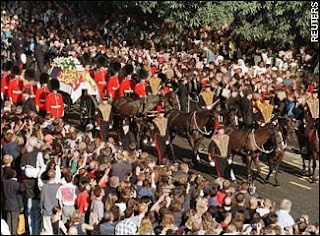


Their return saw a series of precedent-breaking actions. First, the Union Jack was flown at half-mast on the day of her funeral. The day before, the Queen delivered a television broadcast, speaking to the world in tribute to Diana. Despite reported troubles between the two of them, the Queen regarded Diana as "an exceptional and gifted human being". It was her first ever television broadcast, just another sign of the extraordinary reaction, media and public, to her death. While some accused both reactions of being grotesquely dramatic and even insincere, the majority was clearly in favor of the princess. Her funeral was the biggest in pop culture history. Over one million people lined the route from Kensington Palace to Westminster Abbey. 250,000 watched the funeral on large screen televisions at Hyde Park. 33 million people watched the funeral in the UK alone, the second most watched television broadcast of all time, and the most watched since 1966. The same amount watched the funeral in the United States, where there was almost wall-to-wall coverage of Diana from her death. Those people viewed iconic images of Diana's coffin draped in the Royal Standard, her sons, with their father and grandfather, walking behind the carriage, a tearful Elton John singing "Candle in the Wind 1997", and her brother verbally slaying the royal family.
Today, Diana's funeral is still one of the most memorable events in modern history. Her image still inspires fascination, and more importantly to some, big sales. Since that sad day of September 6th 1997, there hasn't been a pop culture moment to match that same kind of media coverage.
That was until around 4pm, twelve years later, on June 25th 2009.
Next, the last years of the King of Pop: married with kids, Invincible, Berlin, Martin Bashir, the trial, and the six months that spelled the end of Michael Jackson's life.
 This week, the UK pop world was stunned by news of the death of Stephen Gately, member of the boyband Boyzone. The Irish group had seventeen consecutive Top 5 hits, from their 1993 debut "Love Me For A Reason" to the 2008 comeback single "Love You Anyway". In between those songs was a little pop gem called "No Matter What", which was primarily sung by Gately (Ronan Keating was also featured).


