Showing posts with label BWU Investigates. Show all posts

Thursday, July 9, 2009

Michael Jackson and Princess Diana: Fallen Rulers of the Media Kingdom, Part 3

http://www.newprophecy.net/Diana_Princess_of_Wales_smiles_at_Tate_July_1_1997.jpg http://i.rollingstone.com/assets/rs/2/1650/images/00284706_lg.jpg

Michael Jackson and Princess Diana are unique in their celebrity because, as a new media age dawned, they attempted to control how they were seen by the world. There were times when it was successful, greatly so. However, by the mid-90's, the methods that worked for them early on began to lose effect, and they were trapped in their own special kind of media hell.

Princess Diana probably didn't realize the extent of reciprocal damage her 1995 Panorama interview would cause. While she succeeded in winning public favor again (especially after a friend of Charles called her mentally ill in a special after the initial airing, confirming her accusations of backdoor sabotage), her interview was looked upon kindly by the Palace. The Queen, apparently fed up with the media circus the family was subjected to by Diana's antics, wrote both her and Charles, suggesting a divorce, something Diana did not want (per the interview). Ultimately, she had no choice, especially after she slyly accused her sons' nanny Tiggy Legg-Bourke of aborting Charles' baby.

The early half of 1996 saw Charles and Di fighting over terms of a divorce. The most publicized aspect of the discussions was whether Diana would retain her title of Her Royal Highness, or HRH. According to the Queen, since Diana would be divorced from the prince, she had no right to the HRH. She had the title taken away, being restyled as Diana, Princess of Wales. The removal of the title hypothetically meant that Diana would have to curtsy to members of the family, even her own children. After the announcement, Diana announced that she was quitting a number of charities, choosing a select few to continue with. The media heavily implied that she did that as retaliation for losing her title. The media also reported of the changes in Diana's staff, who quit over lack of communication and trust with the princess. Divorce also saw an increased effort from the paparazzi to get pictures of her, particularly in a state of distress. Paparazzi followed her everywhere she went and, with a serious downsizing in security, were free to pester her into tears, which the media gladly attached headlines with.

http://img.thesun.co.uk/multimedia/archive/00101/ed_imgRSNN2307AA_101241a.jpgWhat her divorce didn't mean was that she would quit her charity work, and that the media wouldn't be used to promote it. In January of 1997, Diana teamed up with the Red Cross to create an international ban on landmines. She traveled to Angola, where news cameras from round the world documented her journey. That trip showed Diana exemplify both her compassion for suffering and her astute understanding of imagery. When Diana stopped to visit a severely injured girl in a hospital, she covered the girl's body from the prying cameras and demanded that they stepped back from scaring the sick girl. In another astonishing moment, Diana walked amongst active landmines in an uncleared field. When she realized that the media didn't get clear pictures, she did it again. Those pictures were published on front pages worldwide. Her visits to Angola and Bosnia brought unprecedented coverage to an issue often ignored worldwide. She was often cited for the creation of the Ottawa Treaty, which was signed by over 100 countries. Unfortunately, she wouldn't live to see the day.

http://www.martinfrost.ws/htmlfiles/diana_car.jpgOn August 30th, 1997, Diana was dining with her boyfriend at the time Dodi Al Fayed at the The Ritz Hotel in Paris, France. In the weeks prior, Diana and Dodi were heavily photographed frolicking on a yacht owned by Dodi's father Mohammed Al Fayed, owner of Harrod's. They continued their vacation in France, followed by the paparazzi. The photographers and fans were stationed in front of the hotel, and in an effort to escape them, they took the back way out of the hotel. Somehow, paparazzi on scooters were there and, driven by an inebriated Henri Paul, the lovebirds fled with paparazzi hot on their trail. Three minutes after their departure, Paul lost control of the car and it crashed into a pillar in the Pont D'Alma tunnel. Inside the wrecked car were a dead Dodi and Henri Paul, and a barely alive Diana and her bodyguard. As the princess lay dying in the car, lightbulbs flashed as the paparazzi took pictures. Eventually, the French ambulances arrived and took Diana to the hospital. Two hours of surgery was unable to repair the damage to her heart, and she declared dead at 4:00 am.

  http://mydailymirror.com/images/newspapers/1997/09/p19970901.jpg   http://mydailymirror.com/images/newspapers/1997/09/p19970906.jpg   http://mydailymirror.com/images/newspapers/1997/09/p19970904.jpg http://thetimetravellers.files.wordpress.com/2008/02/5.jpg

The news of Diana's tragic death shocked the whole world. The UK alone saw a massive outpouring of grief never experienced before. The tabloid newspapers, who at the time were covering Diana's relationship with Dodi, went into overdrive as they covered her death. Images of the princess at her most saintly adorned nearly every British paper. That didn't stop the public from blaming them for her death, since they used the paparazzi to get pictures of Diana. What wasn't known at the time was that pictures of Diana in the wrecked car were sent to the newspapers, ready for publishing. According to an interview with the editor of tabloid, they were ready to print the pictures, until it was announced that she had died. Almost immediately, he deleted all images from the database. In the late edition of News of the World the day of her death, they proudly proclaimed that they refused to print pictures of a dying Diana. The press got a lucky break when reports from Paris came in blaming Henri Paul for the crash. From then on, the press assigned themselves as the speakers of the public. They took the charge when it soon became clear that the millions who mourned Diana were furious that the royals weren't in London and that the Royal Standard wasn't flying at half-mast. The family was on holiday at Balmoral in Scotland, and the flag on flew when the Queen was in residence at Buckingham Palace, but it didn't matter. The press attacked the family for their lack of public grief. The Sun asked on their front page: "Where is our Queen? Where is her Flag?". The Daily Mirror also questioned their absence with this headline: "Your People Are Suffering. Speak To Us, Ma'am." Even in death, Diana had a significant hold on the media. What was becoming clearer was that an ample part of the hold came from the public who adored her. Sensing media and public apprehension (some papers were publishing reports that many mourners weren't against abolishing the monarchy), the family returned to London.
https://blogger.googleusercontent.com/img/b/R29vZ2xl/AVvXsEgqFJ57Raht569zwOn0Z6bKvt-TUbMAlp6lFjshFRqnoRaNayb6XEwfJcfFNF5GgZFzzu1fo2OVViB8SOuKjEr5JFhwNHZKBHfIUZR_50A2t8qmUvpSUse4ANQTBDxcq_pmzCYRLRgVolJd/s320/diana_process.jpg http://www.royalanecdotes.com/wp-content/DianasFuneral_01.jpg http://media-2.web.britannica.com/eb-media/42/23142-004-1364D4E1.jpg

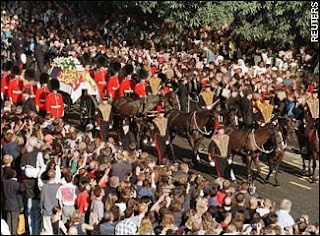
Their return saw a series of precedent-breaking actions. First, the Union Jack was flown at half-mast on the day of her funeral. The day before, the Queen delivered a television broadcast, speaking to the world in tribute to Diana. Despite reported troubles between the two of them, the Queen regarded Diana as "an exceptional and gifted human being". It was her first ever television broadcast, just another sign of the extraordinary reaction, media and public, to her death. While some accused both reactions of being grotesquely dramatic and even insincere, the majority was clearly in favor of the princess. Her funeral was the biggest in pop culture history. Over one million people lined the route from Kensington Palace to Westminster Abbey. 250,000 watched the funeral on large screen televisions at Hyde Park. 33 million people watched the funeral in the UK alone, the second most watched television broadcast of all time, and the most watched since 1966. The same amount watched the funeral in the United States, where there was almost wall-to-wall coverage of Diana from her death. Those people viewed iconic images of Diana's coffin draped in the Royal Standard, her sons, with their father and grandfather, walking behind the carriage, a tearful Elton John singing "Candle in the Wind 1997", and her brother verbally slaying the royal family.

Today, Diana's funeral is still one of the most memorable events in modern history. Her image still inspires fascination, and more importantly to some, big sales. Since that sad day of September 6th 1997, there hasn't been a pop culture moment to match that same kind of media coverage.

That was until around 4pm, twelve years later, on June 25th 2009.

Next, the last years of the King of Pop: married with kids, Invincible, Berlin, Martin Bashir, the trial, and the six months that spelled the end of Michael Jackson's life.

Tuesday, July 7, 2009

Michael Jackson and Princess Diana: Fallen Rulers of the Media Kingdom, Part 2

http://www.mtvblogs.co.uk/files/images/039_30399michael-jackson-posters.jpg http://vipchain.com/wp-content/uploads/2008/04/princess-diana.jpg

By the early 1990's, pop star Michael Jackson and British royal Princess Diana were massive global celebrities, admired the world over for their works. There was little dispute over their influence in popular culture, attributed to the media's unwavering fascination with them. The media's fascination, at this time, began to show its darker shades.

http://www.nobodysells4less.com/images/michael_jackson_1993.jpgMichael's wildly eccentric lifestyle drew the media in, giving them bucket loads of material to discuss, truth or fiction. His guarded nature fanned the flames, since he wouldn't speak about the countless stories written about him. However, that was forced to change in 1993. That year, in the middle of his successful Dangerous tour, Michael was accused of child molestation by a 13-year old boy. Suddenly, the images of Michael with young children (the boy who accused him attended the World Music Awards with his mother as Michael's guests) were given a dark shade. The media ran with that angle almost out of the gate; the New York Post ran this infamous headline: "Peter Pan or Pervert" as the allegations broke. Although he wasn't formally charged, he was still treated like he was guilty. Televisions shows like Hard Copy paid thousands for "revelations" of improper conduct on Michael's part from former employees, even though those were highly incredible. Court documents were leaked, compromising an already weak case. Even with the massive negative response, they still gave Michael the chance to defend himself. In December of 1993, televisions stations worldwide aired Michael Jackson's rebuttal video live from Neverland Ranch, where he told of his humiliation at the court required strip search. There was little sympathy for the singer, even after he became addicted to painkillers to deal with the terrible stress of the trial. To stop the media circus in its tracks, he settled out of court, to a rumored tune of $20 million. While lawyer Johnnie Cochran insisted the settlement wasn't an admission of guilt, that did not stop newspapers of branding him guilty.

http://www.bittenandbound.com/wp-content/uploads/2009/06/lisa-marie-and-michael-jackson.jpg
With the charges somewhat behind him, Michael stunned the world again by marrying Lisa Marie Presley, the daughter of Elvis. The union was met with nearly universal skepticism, believing it was a calculated move to repair his cracked reputation. There was certainly an effort to prove their love; the 1994 MTV Video Music Awards was opened by them, and they shared a jaw-dropping kiss in front of millions. The couple appeared semi-nude in the video of Michael's #1 hit "You Are Not Alone". The same year, they also sat down with Diane Sawyer for Primetime. The interview saw Michael defending everything from his sexuality to his facial changes to even a promotional video for his new album HIStory, was compared to Nazi propaganda film Triumph of the Will. The efforts were futile and ultimately pointless; they divorced the next year. Michael's presence in the media didn't seem to help his album sales. HIStory, which he released in the summer of 1995, was his first album since the allegations. It was a double album; one disc held his greatest hits and the other was full of new material, most of which referring to the allegations. The album served as a test of his selling ability after the scandal. To aid sales, he released the first single "Scream", a duet with Janet. The video that accompanied it was the most expensive ever, costing $5 million. The song was a hit, debuting and peaking at #5. The second single, "You Are Not Alone", became the first ever song on the US charts to debut at #1. Despite the single successes, the album wasn't without controversy. Jackson was accused in the media of antisemitism with the song "They Don't Care About Us", which he vehemently denied. A performance of the British Christmas #1 single "Earth Song" at the 1996 BRIT Awards was crashed by Jarvis Cocker, who accused Michael of portraying himself as Christ. Ultimately, the album sold 3.5 million copies in the United States, less than Dangerous' 8 million sales, and much less than Thriller's 28 million sales. While sales of 3.5 million, especially in this current climate, are nothing to sneeze at, HIStory was deemed a disappointment.

http://img.thesun.co.uk/multimedia/archive/00438/diana_280_438323a.jpgThat three year stretch also saw Diana face some struggle with the media she once dominated so easily. In November of 1993, the Sunday Mirror published secret pictures of Diana working out in a gym, in a unflattering pose. Humiliated, and sick of the media scrutiny, Diana formally withdrew from public life during a speech a month later. The absence was short-lived. She soon got back doing public charity work with cameras following her. What followed her return nearly derailed her public support. 1994 saw James Hewitt publish a book called Princess in Love, where he revealed their affair to the world. His overt betrayal of Diana made him an overnight celebrity, but the media's coverage of him wasn't favorable. Still in Di's favor, the British press referred to him as a "love rat", who violated the princess. Standing on her side didn't stop them from publishing stories about her other conquests, such as her relationship with rugby player Will Carling. Diana's understanding of the media was still strong during these times of indecent exposure, and she didn't pass up an opportunity to upstage her separated husband. The night that he admitted adultery in a televised interview, Diana stepped out for a night at the Serpentine Gallery. The dress she wore, a sexy black fishtail number, stole the front page from Charles. That dress has been referred to as the "revenge" or "up yours" dress.

http://www.bbc.co.uk/home/images/main_promo/news/panorama_diana_wt_r_1.jpgStill, Diana wasn't satisfied with stealing press from Charles. She wanted to finally reveal to the world how she was feeling. Enter Martin Bashir, a reporter with BBC's Panorama. In a secret deal, she filmed an interview with him in 1995. On November 20th, the world sat down and watched as Diana officially blew the lid off the royal family. With downcast eyes, she stunned everyone with her revelations of bulimia, adultery, and loneliness. The most shocking of her interview was her suggestion, if not assertion, that Charles was not fit to be King, she would never be Queen, and that William would be better fit.

Diana's interview with Martin Bashir was one of the definitive moments of her life. It was also her biggest mistake. For someone who was so intelligent with the media before, it is mind-boggling that Diana would think openly challenging the validity of the monarchy's line of succession was a good idea. The Queen certainly didn't think so. Shortly after the interview, Diana and Charles received formal letters from Her Majesty, requesting they divorce immediately.

Michael and Diana were at different stages in their lives in the mid 90's. Diana was to be an ex-wife of a prince, stripped of her HRH. Michael was trying to salvage his career with a new album and marriage. As they navigated their significantly changed lives, the cameras were there, every step of the way. But it is clear that the media played more of a role in the latter parts of their lives than they originally thought.

In Part 3, how Diana and the press worked when she lost her title, and what role the paparazzi played in her tragic death. Also, Michael fights for his life, as odd behavior and sagging sales turned Michael from pop hero to laughingstock.

Monday, July 6, 2009

Michael Jackson and Princess Diana: The Fallen Rulers of the Media Kingdom, Part 1

She was the "Queen of Hearts".

He was the "King of Pop".

The titles may have been honorific, but the global media attention on Michael Jackson and Princess Diana was fit for royalty.

On Tuesday July 7th, the world will watch as the greatest pop star of all time is laid to rest with a televised memorial service at Los Angeles' Staples Center. 1 million people are expected to converge on the city to witness the services, even though it is unlikely they will see anything important. A similar number was assigned to the people who lined the route to Westminster Abbey in 1997, watching in sadness as Britain's fallen princess passed by in a Royal Standard-covered coffin.

Jackson's farewell will most likely be a global watershed event, much like Diana's. In a twisted way, it makes sense that these two public figures have similar impacts at their deaths. There had never been two people like them before, and considering the current crop of A-list celebrities, there may never be again. Michael and Diana lived two completely different lives, but they were arguably the two most visible people on the planet. People Magazine has dedicated nearly 50 covers to Diana, from her engagement to Prince Charles to her fatal car accident in Paris. It is unlikely that a country exists without one person that owns a copy of Thriller. The world was fascinated by their every move, good and bad, and proceeded to film and write about them for a collective three decades. Their deaths haven't slowed the fascination at all; in some cases, it intensified it.


So, why all of the attention on these two people? Why did the passing of an ex-wife of a British prince call into the question the relevance of the monarchy? How is it possible for a singer to continue to dominate television, print, and radio, two weeks into his death?

Because, in life, no one else quite understood the power of the media like them. Michael, with his music, style, and eccentric behavior, and Diana, with her beauty, charity, and her calculated understanding of image, used newspapers, magazines, and television to elevate themselves to iconic status. If the media was a kingdom, they were the undisputed king and queen. Their shared tragedy is that the media staged a coup d'etat of epic proportions. Through hurtful and stressful headlines and obsessive paparazzi stalking their every move, the media who once ate out of their palms, took control of their images. As we've seen, the results were unprecedented, and ultimately tragic.

Diana and Michael are unique because they both reached their peak as the world began to shift to a celebrity-dominated mass media culture. With the advent of cable and the booming success of tabloids, public figures were placed under a microscope to be dissected at a molecular level.

In the 80's, just as the obsession with celebrity reached a new height, Michael Jackson and Princess Diana emerged as global forces to be reckoned with. Michael, with his album Thriller sitting atop the charts for a mind-boggling 37 weeks, was the biggest pop star in the world. His music videos turned MTV into a cultural touchstone. His dancing, particularly the moonwalk, were desperately practiced by the masses. His style, including the red leather jacket and the sequined glove, were must-haves. Diana, the gorgeous young wife of Prince Charles, had captured the imagination of not just the UK, but the whole world. Her beauty, style, and charity work easily stole headlines from the other royals, especially her husband. The popular divide had grown so large, that people on one side of the street booed when Diana chose the other side to chat with and they were stuck with Charles.

Michael and Diana were global stars, and for this newly-emerging phase in pop culture, they were guinea pigs. Magazines provided continual coverage of the two, and cameras followed them everywhere they went, regardless of their privacy. The attention only boosted their global profiles, and soon, they found themselves with an excellent opportunity to control how the public saw them. They both realized the media's influence with the public. They harnessed that power to work for them. Michael wanted to portray himself as mysterious, odd, and interesting. His image was unlike any other in the 80's; he was constantly seen in military-inspired clothes, and as the years went by, his skin began to progressively lighten, which he attributed to a skin disease called vitiligo. When his hair caught fire during the filming of a Pepsi commercial in 1984, Michael, covered in blankets and bandages, waved goodbye to his fans with his sequined glove on. His companions included Brooke Shields, Emmanuel Lewis, and Bubbles the chimp. If that didn't keep people talking, the stories published in supermarket rags like The National Enquirer definitely did. The most infamous story was that Michael slept in a hyperbaric oxygen chamber to live to the age of 150. The strategy worked; sales of his album Thriller still rank as the best in world history and seven out of nine singles from the album were Top 10 smashes, a record that still stands. The public was infatuated with the star, completing the transformation from child star to pop megastar.

Diana also wanted to create an image. She was terribly unhappy in her marriage to Prince Charles, who had returned to his mistress Camilla Parker-Bowles. In the beginning, she had virtually no power and support from the other members of the family was lacking at best. What she did have was the adoration of both the public and the press, who benefitted greatly from her image on their covers. From there, Diana began to use the media to work in her advantage. The cameras that followed her inadvertently promoted low-profile issues like homelessness and AIDS, an illness she was credited for single-handedly erasing the stigma from. She used them to upstage and undercut her husband. Powerful images of solidarity, like her alone in front of the Taj Mahal and her pulling away from Charles' kiss at a polo match, were beamed all over the world. The press painted her as a suffering champion for the people and him as a dim, philandering cad unfit to reign.

Michael and Diana achieved their goals of media manipulation, and in turn, they became virtually impossible to escape. Barely a month went by when a new development in their lives wasn't covered by the press. In the beginning, the press was mostly positive, with some unseemly stories from the tabloids. That ratio began to shift, at different times for them. For Michael, the negativity from the media began in the late 80's, as they ran wild with the "weird" image the pop star was trying to cultivate. The stories became more bizarre, like the rumor that he was looking to purchase the bones of the Elephant Man. The scrutiny over his facial changes intensified, and people began to speculate about the number of plastic surgeries he had. His reclusive nature didn't help matters. Instead of debunking the multiple controversies, he blocked himself from the world, hiding behind his sprawling Neverland Ranch. In retaliation, the media began referring to him as "Wacko Jacko", a moniker first created by the British press.


Diana saw the media begin to cross the line in the early 90's, as it was becoming clear that her marriage to Prince Charles was falling apart. Like her pop star counterpart, she used the media to convey a specific image. As her marriage unraveled, though, she wanted the media to be a vessel to expose her agony as a royal. Along with her acute understanding of the power of the image, she enlisted the help of Andrew Morton to write a biography. The book, Diana: Her True Story, was released in 1992 and was an absolute bombshell, shattering the mystique surrounding the royal family. Revelations of eating disorders, suicide attempts, and affairs on Charles' part stunned a world who bought into the fairytale from ten years prior. The scandalous book turned up the fervor of the media; the British press was especially obsessed with Diana, desperate for any little story about her to fill a front page. Her image still a best-seller a decade into her reign, there was a high demand for exclusive pictures of the princess.  Deployed in their pursuit were freelance photographers, also known as the paparazzi, who followed Diana everywhere she went, to her dismay. Even with the bother of the paparazzi, she still had a significant amount of the media loving her, painting her as the wronged woman. That image would soon be shattered, thanks to herself, Charles, the royals, and a man named James Hewitt. That stretch of time would also see Michael fall out with favorable media coverage, as shocking allegations derailed his career, and ultimately, his life.

In Part 2, Diana and Michael see their lives change forever as their efforts to control the media fail miserably, ultimately resulting in their tragic ends.

Saturday, July 5, 2008

Singles Artists vs Albums Artists: A BWU Investigation (Part 2)

A LOOK BACK...

Note: For the full investigative report, please visit the BWU Website and click on the "BWU Investigations" link

In order to understand which type of artist is more valuable, let's look back to the peak of album sales.

The best selling record of 2000 In 2000, the music industry was at its greatest heights yet. According to the New York Times, 785.1 million albums were bought by consumers. The numbers may seem huge, but it shouldn't be when the list of albums released that year is observed. 2000 saw some of the biggest releases of the new millennium. The booming teen pop genre saw new albums from The Backstreet Boys, 'N Sync, and Britney Spears. Records from Eminem and Creed also caused quite a stir.

The most successful genre from the late 90's/early 00's era was teen pop. Artists like Britney, Christina, 'N Sync, and the Backstreet Boys were the focal point of the industry, selling millions with ease.

There are some significant differences between Christina Aguilera and the other three, though. Britney, Backstreet, 'N Sync were all on Jive Records, while Christina was with RCA. Also, Christina's debut went 8x Platinum, while the other three scored at least 2 Diamond albums.

Wait. How is that possible? How could Christina only sell 8 million, while Britney's debut sold 14 million? Many will say that Christina was the better artist (she won the Best New Artist Grammy in 2000). Shouldn't the sales reflect that?

Not necessarily. A possible reason for Britney's success over Christina was the single/album argument.

Jive Records' initiative was to sell as many albums as possible. How did they do that? By stopping the physical release of their artists' singles.

image Many of Britney's singles charted in the 20s and 30s of the Hot 100. Why? Because Jive didn't release a physical copy of the single. The only way the singles were able to chart was through radio play, which was frequently high. Without a physical copy of their favorite single, fans were forced to buy the full album. Millions who would've rather just bought "Sometimes" or "Oops!... I Did It Again" separately bought the album. The latter is a good example of Jive's dependence on radio. "Oops!" peaked at #9 without a single release. The exposure through radio had fans desperately wanting the single, which would only be available when the album of the same name was released a month later. The suspense was lifted on May 16th, when Oops!...I Did It Again was released. Within a week, the album sold 1.3 million copies, the highest total for a female artist. Britney's other singles (save for "Stronger") were also held back physically, pushing the album sales to the 10 million mark.

image Christina, on the other hand, had three #1 singles from her debut. However, she didn't sell as much as Britney. All of her singles were physically released, meaning that people didn't have to  buy the album to get the song they wanted, like Britney. If her singles didn't have physical releases, she probably would've sold more. Likewise, if Britney's singles were released physically, many of them would've gone to #1 as well.

The major reason for the pop era's success, at least in terms of Jive, was the importance put on the album instead of the single. Yes, millions were spent on music videos that would go to #1 on TRL, but the plan was for people to flock to the stores not for a CD single, but the album itself.

In the most profitable era of music, the albums artist was placed above the singles artist. But what about now? As the album sales drop and the singles sales rise, does it remain the same?

To Be Continued...

(For the full report, including in depth sales figures, please visit the BWU Investigations page on the BWU website)

Thursday, July 3, 2008

Singles Artists vs Album Artists: A BWU Investigation (Part 1)

WHAT IS A SINGLES ARTIST? ALBUMS ARTIST?

In the music industry, for the most part, there are two types of artists; the singles artist and the albums artist.

A singles artist is an artist who has more success releasing singles than full albums. That doesn't mean they aren't good singers/bands, but it means that their fans (and the public) prefer their single releases to their album releases. Singles artists tend to have multiple Top 10 singles on charts around the world, even though their album sales may not reflect that.

Example: Rihanna

image

Rihanna is easily the best example of a singles artist in this era. She is easily one of the biggest singers on the planet, with a bevy of Top Ten singles to her name. Here is the full list (US Chart only):

  • Pon De Replay - 2005 (#2)
  • SOS - 2006 (#1)
  • Unfaithful - 2006 (#6)
  • Break It Off - 2006 (#9)
  • Umbrella - 2007 (#1)
  • Don't Stop The Music - 2007 (#3)
  • Hate That I Love You - 2007 (#7)
  • Take A Bow - 2008 (#1)
  • Disturbia - 2008 (#1)

With 9 Top 10 singles in only 3 years time, Rihanna is one of the biggest pop artists on the scene. Holding such a title would lead to the assumption that she would be a big album seller as well. That is not the case. In the United States, she has sold 4.2 million copies between her three albums Music of the Sun, A Girl Like Me, and the smash Good Girl Gone Bad. Her highest sales come from the latter, which has sold 1.4 million copies after a year. Her singles have fared much better in sales. When combined, Rihanna's singles have sold 10 million in the United States alone.

An albums artist, however, is very successful when it comes to racking up album sales. It may not necessarily be as easy to score successful singles, but the sales of the record tend to make up for it.

Example: Amy Winehouse

image

You would think that, considering that Amy is one of the most talked-about singers in recent memory, she would have success on both the albums and singles chart. Not true. Her critically-lauded 2007 album Back To Black, has sold 10 million copies worldwide, including 2 million here in the States and 5 million in Europe. However, her singles aren't as successful. In the US, she only has 1 Top 10 single, "Rehab" at #9. In the UK, where her album still resides in the top 50, she's had two: Rehab at #7 and Valerie at #2.

With the two primary artist types identified, the question can be raised, which one is better for the music industry? In an era where the CD single is dead, digital sales are the standard, and only three albums in the first 6 months in the US have gone platinum, which type of artist is more important to maintain an industry in desperate need of repair and change?

In Part 2, how did the industry handle single and album sales in 2000, the year with the largest record sales in history. To be discussed: Britney Spears, Backstreet Boys, N Sync, Eminem, and more.

Wednesday, July 2, 2008

Singles Artists vs Albums Artists: A BWU Investigation (Introduction)

Never before has the music industry been in so much peril.

Album sales are drastically lower than in the past, and even the rapid increase in digital sales isn't making up for the difference. Also, some of the industry's biggest artists are abandoning labels altogether for more revolutionary deals (Madonna and Live Nation, for example). As a result, many record companies are forced to downsize and reconfigure their business plans in order to stay afloat. These changes raise a few questions about the industry's current structure. One of the most important is, which type of artist is more valuable: an artist who can score multiple top 10 singles or an artist who can score multiple top 10 albums?

This series of posts will examine the significance of both types of artist. Recent music history will be delved into, especially 2000, where album sales were at their peak. Artists themselves will also be explored, how their single and album sales compare and contrast.

I hope you guys enjoy this BWU Investigation Special!

Sunday, March 9, 2008

Is Teen Pop Back? Part One of A BWU Investigation


Britney Spears. Backstreet Boys. NSYNC, Christina Aguilera. 10 years ago, they owned the music world. They smashed sales records with every album. They shut down New York's Times Square every time they appeared on MTV's TRL. Their music videos became world-premiere events. Back before iTunes, iPods, and YouTube, they were music.

10 years later?

Britney Spears has become a tabloid disaster, Christina Aguilera has found moderate success with her latest album, the Backstreet Boys are shells of their former selves, and NSYNC has disbanded (Lance came out of the closet, Chris voices Nickelodeon cartoons, Joey hosts red carpet events, JC is doing whatever, and Justin has become a global megastar). By the end of 2002, the teen pop movement was effectively over.

Is it time for a new one?

This special feature will examine the burgeoning "Disney pop" movement, equipped with its own ready-made superstars. From Hannah and Miley to Aly and AJ, I pose the question that people asked 10 years ago:

Is this a phase or will it change music forever?

nrelate